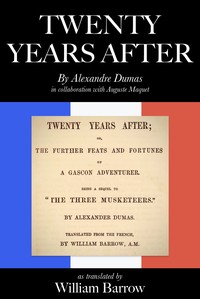
Twenty Years After opens with a direct address to the reader's memory of The Three Musketeers, but quickly establishes its own distinct tone through the aging of its heroes. D'Artagnan, now a lieutenant in the Musketeers, is introduced in a state of restless dissatisfaction, his dialogue sharp with the Gascon bravado that defined his youth but now tinged with weariness. The narrative voice shifts between brisk action and reflective commentary, often undercutting heroic moments with practical observations. For instance, when D'Artagnan spares a rebel after learning he is a son, the authorial choice to have him say 'that is a different thing' reveals a code of honor that is personal rather than political. The prose is dense with physical detail—the weight of a half-pistole, the feel of a battered hat—that grounds the swashbuckling in tangible reality.
Diction and the Weight of Twenty Years
The language of the novel carries the burden of its title. Dumas and Maquet use vocabulary that signals maturity: characters speak of 'animosities' rather than quarrels, and the narrator describes Cardinal Richelieu's 'shade' as a lingering influence. D'Artagnan's internal monologue, when he reflects on his stalled career, employs a measured, almost cynical diction that contrasts with the impulsive exclamations of his youth. The word 'faith' appears as an oath, but it is often hollow, a verbal tic rather than a conviction. This shift in word choice—from the exuberant to the pragmatic—mirrors the characters' changed circumstances. Even the chapter titles, such as 'D'Artagnan in his Fortieth Year,' emphasize the passage of time through precise age markers, a deliberate authorial choice to anchor the narrative in the characters' physical and emotional aging.
Dialogue as a Tool for Character Revelation
Dialogue in the excerpts serves not only to advance the plot but to expose the inner conflicts of the characters. When D'Artagnan confronts Friquet, the exchange is layered with social tension: D'Artagnan's authoritative commands are met with Friquet's quick-witted evasion, revealing the lieutenant's frustration with a world where even a former choirboy can defy him. The dialogue between D'Artagnan and Raoul is particularly telling. D'Artagnan's clipped, practical questions—'Are you in pain?'—contrast with Raoul's more formal, deferential replies, highlighting the generational gap and D'Artagnan's role as a reluctant mentor. The authorial choice to have D'Artagnan speak in short, imperative sentences during the riot scene ('Go,' 'Wait, wait') underscores his authority and decisiveness, while his rare moments of hesitation, such as when he says 'that is a different thing,' are marked by a shift to longer, more reflective phrasing.
Description and the Physicality of Setting
The descriptive passages in the excerpts are notable for their focus on physical objects and spatial relationships, which serve to ground the political intrigue in tangible reality. The broken carriage that 'must be doomed' is not merely a plot device but a symbol of the fragile state of authority. D'Artagnan's observation that 'the carriage in which a Broussel is to be arrested ought to be able to bear ten thousand men' uses hyperbole to critique the incompetence of those in power. The setting of the Quai, with its specific geography from Pont Neuf to Quai Saint Michael, is rendered with precision, creating a sense of real space that the characters move through. This attention to physical detail extends to the characters' bodies: Raoul's 'battered hat' and the 'flower-pot' that caused his bruise are described with a matter-of-factness that emphasizes the violence of the crowd. The authorial choice to include such concrete details anchors the historical fiction in a sensory world.
Recurring Motifs and Structural Choices
Several motifs recur in the excerpts, revealing authorial preoccupations. The motif of the 'shade' or ghost of the past appears in the first chapter title and echoes throughout: characters are haunted by their former selves and by figures like Richelieu. The motif of the 'half-pistole' in chapter titles and dialogue underscores the role of money and luck in the characters' lives. Structurally, the authors use chapter titles that often summarize or comment on the action, such as 'Wealth does not necessarily produce Happiness,' which primes the reader for ironic or didactic content. The narrative also employs a technique of delayed revelation: the reader learns of D'Artagnan's age and rank gradually, through his own reflections and the observations of others. This structural choice mirrors the theme of time's passage, forcing the reader to piece together the characters' histories from fragments of dialogue and description.
Readers approaching Twenty Years After should attend to the ways in which Dumas and Maquet use language to signal change. The diction, dialogue, and description are not merely ornamental but serve as indices of the characters' internal states and the shifting political landscape. Pay particular attention to moments when characters pause or speak in a manner inconsistent with their earlier selves—these are the authorial fingerprints of a sequel that is as much about the weight of history as it is about adventure.
I remember reading this in my grandmother’s armchair, the muffled noise of the street far away. The strain between old friends, that heavy quiet of loyalty strained by time—it feels like the ache in Eloisa’s letters, her patience shadowed by knowing. Twenty years feels like grief, or a different kind of love. Eloisa — Reading Companion once caught that exact paused breath for me. Strange how pages remember us.