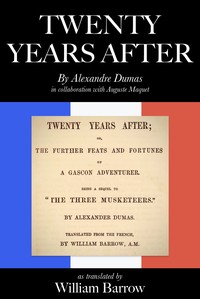
About 1,089 minutes
Twenty years after — Themes and Context
Historical Psychological Social Fiction
250,385 recorded words. 233 minutes difference from this book's estimate.
View Gutenberg source #1259
The catalog record for Character Sketches of Romance, Fiction, and the Drama, Vol. 4 A Revised American Edition of the Reader's Handbook — Context and Discussion provides practical reading context through 196,753 words, 14 hr 16 min estimated reading time, and 31 detected text sections.
The text analysis averages about 10.0 words per sentence, while the detected sections provide another way to judge how the source is divided.
Project Gutenberg metadata also associates the work with “Literature -- Dictionaries,” connecting these edition facts with the source record’s subject description.
Explore this collection
These alternatives are selected using recorded categories and estimated reading time.
About 1,089 minutes
Historical Psychological Social Fiction
250,385 recorded words. 233 minutes difference from this book's estimate.
View Gutenberg source #1259About 370 minutes
Historical Psychological Social Fiction
84,955 recorded words. 486 minutes difference from this book's estimate.
View Gutenberg source #75979About 320 minutes
Historical Psychological Social Fiction
73,470 recorded words. 536 minutes difference from this book's estimate.
View Gutenberg source #76074Search stored excerpts and compare books → Choose by your preferences →
Choices use stored catalog measurements. Estimates vary with reading speed. A shared category is a catalog label, not a claim that two books have the same argument or literary quality.
Search reads excerpt text stored with this catalog and links to its associated Gutenberg record. The connection is stored in the site database; this tool does not recheck that every excerpt is word-for-word identical to that external record. Excerpt search does not cover every chapter and does not verify historical publication dates.
Catalog snapshot checked: 2026-09-25. Coverage: 97 public books, 97 available source excerpts.
Read the complete public-domain text at its original source.
Read on Project GutenbergThe fourth volume of Ebenezer Cobham Brewer's Character Sketches of Romance, Fiction, and the Drama covers entries from 'Falkland' to 'Mark,' continuing its alphabetical march through literary and historical figures. The excerpts reveal a work that is part dictionary, part commonplace book: entries range from plot summaries of Cumberland's The Brothers to notes on violin makers and the medieval legend of Virgil as enchanter. The catalog subjects—Literature—Dictionaries, Allusions, Fiction—Dictionaries—accurately describe the book's scope, but the excerpts also show a surprising density of classical and Italian Renaissance references, suggesting a broader cultural purview than the subject headings might imply.
The entries vary widely in length and depth. Some, like the one for The Brothers, provide a full plot summary: a shipwreck, a mistaken betrothal, and a reconciliation. Others, such as the entry on violin makers, are terse lists with evaluative rankings—Stradivari is called "the best," Amati "the next best." The Virgil entry is particularly rich, weaving together Dante's allegory, a medieval romance, and a humorous anecdote about a basket. This mix of high and low, serious and comic, is characteristic of Brewer's approach. The volume also includes cross-references to other entries, though the transcriber notes that these are not hyperlinked in the digital edition.
The edition was "Revised American" by Marion Harland, but the excerpts give little direct evidence of her changes. The transcriber's note, however, reveals several textual issues: the original promised illustrations that were absent from the source copy, and the page numbers for the list of illustrations were struck out and corrected by hand. The text was originally printed in two columns, which could not be reproduced. These details remind the reader that the digital text is a reconstruction, not a facsimile. The presence of diacritical marks (ă, ā, etc.) suggests the original included pronunciation guides or scholarly apparatus now partially lost.
The excerpts show Brewer drawing on a wide range of sources: English drama (Cumberland, Shakespeare), Italian poetry (Dante, Ariosto), classical mythology, and even contemporary references like Sir Walter Scott as "The Great Wizard of the North." The Virgil entry alone touches on the Gesta Romanorum, Dante's Divine Comedy, and a folk tale from Stephen Hawes. This eclecticism is the book's strength, but it also means the entries can feel disjointed. The catalog subject "Allusions" is apt: the volume is a tool for identifying references, not a sustained argument. Readers should approach it as a browser's delight, not a systematic study.
This volume rewards browsing more than sequential reading. The entries are best sampled for their unexpected juxtapositions—a note on violin craftsmanship next to a plot from Scott. The editorial history, with its missing illustrations and handwritten corrections, adds a layer of material interest. For those tracing literary references or seeking quick summaries of minor works, this is a useful, if idiosyncratic, companion.
There’s something about these old sketches—Falkland to Mark—that feels like flipping through a worn commonplace book, where every name carries a half-forgotten story. I found myself thinking of Betty Wales afterward, not because they resemble each other, but because both remind me how we carry our fictional companions quietly, the way we hold onto certain afternoons. Betty Wales decides — Themes and Context insists on that same gentle lingering, somehow.
Use these questions to collect your thoughts before moving on.