About 279 minutes
A little Irish girl — Reading Notes
Historical Psychological Social Fiction
64,030 recorded words. 25 minutes difference from this book's estimate.
View Gutenberg source #75934
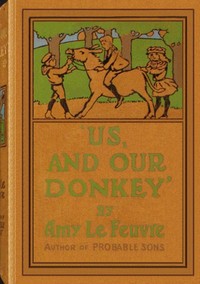
The source record for "Us, and our donkey" — Edition Insights measures this digital text at 58,363 words, 4 hr 14 min estimated reading time, and 6 detected text sections.
The text analysis averages about 15.2 words per sentence, while the detected sections provide another way to judge how the source is divided.
Project Gutenberg metadata also associates the work with “Christian life -- Juvenile fiction,” connecting these edition facts with the source record’s subject description.
Explore this collection
These alternatives are selected using recorded categories and estimated reading time.
About 279 minutes
Historical Psychological Social Fiction
64,030 recorded words. 25 minutes difference from this book's estimate.
View Gutenberg source #75934About 209 minutes
Historical Psychological Social Fiction
47,866 recorded words. 45 minutes difference from this book's estimate.
View Gutenberg source #71028About 300 minutes
Historical Psychological Social Fiction
68,827 recorded words. 46 minutes difference from this book's estimate.
View Gutenberg source #73301Search stored excerpts and compare books → Choose by your preferences →
Choices use stored catalog measurements. Estimates vary with reading speed. A shared category is a catalog label, not a claim that two books have the same argument or literary quality.
Search reads excerpt text stored with this catalog and links to its associated Gutenberg record. The connection is stored in the site database; this tool does not recheck that every excerpt is word-for-word identical to that external record. Excerpt search does not cover every chapter and does not verify historical publication dates.
Catalog snapshot checked: 2026-09-25. Coverage: 97 public books, 97 available source excerpts.
Read the complete public-domain text at its original source.
Read on Project GutenbergThe first-person narrator, Grisel Marjoribanks, announces her intention to keep a record of her family's life in a new village, immediately establishing a voice that is self-aware and slightly defensive: "Of course the boys say I shan't keep it up, but I say I shall." The opening chapter reveals the recent death of her mother from pneumonia, a loss Grisel conveys through concrete, sensory details—the cut-down winter jacket she now hates, the nurse who cost money, the final goodbye. This direct, unadorned handling of grief sets the emotional tone for a story that balances domestic hardship with the children's spirited schemes involving their donkey, Andy.
Grisel's narrative voice is marked by frequent self-interruption and a conversational rhythm that mimics spoken thought. She begins a sentence about her mother's illness, then breaks off: "I really can't spell it, but I know it begins with a 'p' which you don't pronounce." Later, she cuts herself short after describing the death: "I won't write any more; it makes me cry." These moments of hesitation and emotional withdrawal are not stylistic flaws but deliberate choices that signal the narrator's struggle to maintain composure. The text also includes Grisel's commentary on her own writing process—she worries about being a "prig" and resolves to keep her account focused on others rather than herself. This meta-awareness gives the narration an intimate, unpolished quality that distinguishes it from a more formal third-person account.
The donkey Andy is introduced not as a pet but as a fractional asset: Puff, the youngest, claims he has "one-fifth of it," while the older children negotiate a weekly schedule for its use. The animal becomes a practical tool for the children's adventures and a symbol of their cooperative ethos. When Grisel proposes a free carrying service on Wednesdays, she explicitly connects the donkey to her father's ministerial example: "father always says his time, and as much as possible his goods, are at his parishioners' service. So Andy is going to be at their service every Wednesday." The donkey thus mediates between the children's play and their moral aspirations, enabling small acts of charity such as offering lifts to an old woman carrying sticks. The text treats Andy as a matter-of-fact resource, not a sentimentalized companion.
The children frequently frame their actions in the language of medieval knighthood, a motif that surfaces in their dialogue and Grisel's reflections. Denys describes offering lifts to strangers as something "the knights did in the olden times," and Aylwin eagerly proposes they "drive on and rescue somebody from somebody." This chivalric vocabulary—"adventures," "rescue," "faithful"—is undercut by the mundane reality of a crowded donkey-cart and the lack of any dramatic encounters. The gap between the children's romantic aspirations and their ordinary circumstances creates a gentle irony. Grisel herself ponders the meaning of faithfulness after reading a Latin motto from a tomb, wondering "how big a love I had for my Master." The knightly ideal is thus internalized as a moral standard rather than a literal quest.
The excerpts contain distinctive speech patterns that differentiate the siblings without heavy exposition. Puff, the youngest, uses babyish pronunciations such as "effelun net' birfday" and refers to God as the giver of a pet elephant, revealing both his age and his literal faith. Denys speaks with a tone of fairness and practicality: "Well, there are six days in the week, not counting Sunday. We four could have it in turns." Lynette's contributions are brief but pointed, as when she questions the practicality of Grisel's free service plan. The boys' teasing nickname for Grisel—"Grizzy"—and their mockery of her quoting Latin from a church tomb establish a sibling dynamic of affectionate rivalry. These vocal tics, preserved in the first-person narration, give each child a recognizable presence without authorial summary.
Readers attentive to the interplay between Grisel's stated intentions and her actual narrative choices will find a layered portrait of a child negotiating grief, responsibility, and the desire for meaningful action. The text rewards attention to its small inconsistencies—the resolutions that falter, the plans that collide with reality—as clues to the narrator's developing self-awareness. The donkey Andy, far from being a mere prop, anchors the family's daily life and their attempts to translate high ideals into practical kindness.
Reading Us, and our donkey, Grisel’s quiet resolve to serve Andy’s carrying errands reminded me of leafing through Character Sketches of Romance, Fiction, and the Drama, Vol. 4 A Revised American Edition of the Reader's Handbook — Context and Discussion. Both feel like old friends—one walking beside a donkey, the other listing names I half-remember. There’s comfort in that, the way small records hold whole lives.
Create a short personal record of your experience with this book.