About 233 minutes
Christina and the boys — Key Ideas to Explore
Fantasy Juvenile Worlds
53,475 recorded words. 0 minutes difference from this book's estimate.
View Gutenberg source #75332
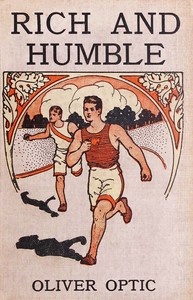
The source record for Rich and humble — Themes and Context measures this digital text at 53,478 words, 3 hr 53 min estimated reading time, and 25 detected text sections.
The text analysis averages about 15.4 words per sentence, while the detected sections provide another way to judge how the source is divided.
Project Gutenberg metadata also associates the work with “Conduct of life -- Juvenile fiction,” connecting these edition facts with the source record’s subject description.
Explore this collection
These alternatives are selected using recorded categories and estimated reading time.
About 233 minutes
Fantasy Juvenile Worlds
53,475 recorded words. 0 minutes difference from this book's estimate.
View Gutenberg source #75332About 223 minutes
Fantasy Juvenile Worlds
51,073 recorded words. 10 minutes difference from this book's estimate.
View Gutenberg source #76759About 222 minutes
Fantasy Juvenile Worlds
50,997 recorded words. 11 minutes difference from this book's estimate.
View Gutenberg source #71239Search stored excerpts and compare books → Choose by your preferences →
Choices use stored catalog measurements. Estimates vary with reading speed. A shared category is a catalog label, not a claim that two books have the same argument or literary quality.
Search reads excerpt text stored with this catalog and links to its associated Gutenberg record. The connection is stored in the site database; this tool does not recheck that every excerpt is word-for-word identical to that external record. Excerpt search does not cover every chapter and does not verify historical publication dates.
Catalog snapshot checked: 2026-09-25. Coverage: 97 public books, 97 available source excerpts.
Read the complete public-domain text at its original source.
Read on Project GutenbergBertha Grant opens the story by asking her father for ten dollars—not for herself, but to support a missionary to the heathen. This early request establishes a pattern: Bertha's concerns are consistently outward, directed toward others' welfare, even as her own family's finances tighten. The novel's title, Rich and Humble, signals a central tension between material wealth and inner disposition, a theme that plays out through contrasting sibling paths. Bertha's brother Richard, described as "thoughtless and flighty," abandons his sister to seek fortune in New York, while Bertha remains behind, scanning shop windows for work. The excerpts show a narrative that values steady, self-sacrificing conduct over impulsive ambition.
Bertha is not a passive heroine. Though she is often anxious—she trembles at Richard's letter, feels "a sense of loneliness"—she acts decisively. She requests money for a missionary, she walks the streets of Whitestone looking for a "Saleswoman Wanted" sign, and she arranges for the boy Noddy to stay with Ben. Her agency is quiet, grounded in practical steps rather than grand gestures. The narrator notes that "life had suddenly become real to her, and stern necessity compelled her to make it earnest." This sentence captures the novel's moral framework: earnestness, not brilliance, is the virtue rewarded. Bertha's humility is not passivity but a willingness to do "anything that she could, even to labor with her hands."
Richard's letter to Bertha is a study in contrast. He boasts of his "first success in earning money" and declares he will find employment "agreeable and profitable." The narrator, however, undercuts this optimism: Richard is "thoughtless and flighty," and Bertha fears he will "fall into evil company." The city is described as "a bad place for him, under any circumstances, but doubly so if he had no one to give him a friendly word of advice." This warning reflects the novel's didactic strain: youthful confidence, untempered by humility or guidance, leads to danger. Richard's path is the foil to Bertha's—where she calculates and consults, he rushes. The excerpts do not reveal his fate, but the pattern is set.
Throughout the excerpts, money is never neutral. Bertha's request for ten dollars is tied to a missionary cause; Richard's five-dollar job is a boast. When Bertha realizes she has "less than half a dollar in the world," the thought comes "with fearful force." The novel uses financial scarcity to test character. Bertha's response is not despair but a methodical search for work. The narrator emphasizes that she is "willing to do anything that she could," linking economic necessity to moral earnestness. The catalog subjects—charity, theft, temptation, humility—all converge on the handling of money. The excerpts suggest that the book treats wealth less as a goal than as a medium through which virtue or vice is revealed.
Readers approaching Rich and Humble should attend to the small decisions that define character: a request for a donation, a letter left unopened, a walk down a street. Oliver Optic builds his moral lessons not through sermons but through concrete, everyday choices. The excerpts offer only fragments of the siblings' journeys, but the pattern of contrast—between Bertha's steady humility and Richard's restless pride—is already clear. The novel rewards attention to how each character responds to limitation.
The rain kept time with Bertha’s quiet choices, and I found myself thinking about how restraint can be its own kind of courage. Later, idly turning pages, that same hush led me to Neesby Court — Context and Discussion, where a different household wrestles with similar ghosts of pride and patience. One afternoon simply opened into another, like rooms sharing a wall.
Use these questions to collect your thoughts before moving on.