About 361 minutes
The oak staircase — A Closer Reading
Fantasy Juvenile Worlds
82,906 recorded words. 18 minutes difference from this book's estimate.
View Gutenberg source #72455
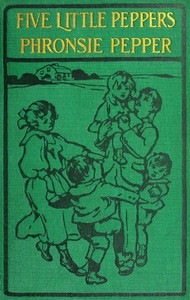
For Phronsie Pepper — Reading Notes, the stored edition analysis reports 78,818 words, 5 hr 43 min estimated reading time, and 35 detected text sections.
The text analysis averages about 14.8 words per sentence, while the detected sections provide another way to judge how the source is divided.
Project Gutenberg metadata also associates the work with “Poor -- Juvenile fiction,” connecting these edition facts with the source record’s subject description.
Explore this collection
These alternatives are selected using recorded categories and estimated reading time.
About 361 minutes
Fantasy Juvenile Worlds
82,906 recorded words. 18 minutes difference from this book's estimate.
View Gutenberg source #72455About 376 minutes
Fantasy Juvenile Worlds
86,394 recorded words. 33 minutes difference from this book's estimate.
View Gutenberg source #75657About 300 minutes
Fantasy Juvenile Worlds
68,844 recorded words. 43 minutes difference from this book's estimate.
View Gutenberg source #76562Search stored excerpts and compare books → Choose by your preferences →
Choices use stored catalog measurements. Estimates vary with reading speed. A shared category is a catalog label, not a claim that two books have the same argument or literary quality.
Search reads excerpt text stored with this catalog and links to its associated Gutenberg record. The connection is stored in the site database; this tool does not recheck that every excerpt is word-for-word identical to that external record. Excerpt search does not cover every chapter and does not verify historical publication dates.
Catalog snapshot checked: 2026-09-25. Coverage: 97 public books, 97 available source excerpts.
Read the complete public-domain text at its original source.
Read on Project GutenbergMargaret Sidney closes the Pepper series by returning the family to Badgertown, where Phronsie, now grown, takes on a more central role. The author's preface frames the book as a response to readers' requests, yet the narrative itself reveals Sidney's characteristic method: letting characters "talk and move and act" without forcing a predetermined plot. This approach is evident in the dialogue, where characters' voices carry the weight of moral dilemmas and social comedy alike.
In the excerpt from Chapter XV, Joel's awkward apology to Amy Loughead showcases Sidney's ear for natural speech. Joel stammers, "I don't know as you'll go with me—I'm sure I shouldn't, if the cases were reversed," while Amy's reply—"I was a little goose, Mr. Pepper, in the old days"—shifts blame to herself, a pattern of gracious self-deprecation that recurs throughout the series. The scene balances embarrassment and resolution without sentimentality.
Sidney uses dialogue not merely to advance plot but to stage ethical negotiations. In the Hingham driving scene, Joel's internal conflict is externalized through his halting speech and physical gestures: he "ground his boot into the gravel" and later "hung his head, wishing he were small enough to be whipped." Amy's response—"Do you wish to, Mr. Pepper?"—forces him to articulate genuine desire rather than obligation. The exchange avoids direct moralizing; instead, the characters' word choices reveal their growth. Phronsie's quiet insistence that Joel take Amy "all the more because you did speak so" exemplifies her role as a gentle moral compass, a function she performs through understated dialogue rather than lecture.
Sidney's descriptive passages ground the story in tangible, homely details. The preface mentions the "little brown house" as a symbolic backdrop, but the excerpt shows how specific objects—music, a cart, a bay horse—create texture. When Grandpapa appears "around the curve in the path," the setting is evoked through movement and sound rather than static description. The phrase "Johnson to put my bay in" implies a stable, a servant, and a routine, all without elaboration. Sidney's restraint in description allows readers to infer the comfortable, ordered world of the Peppers' later life, contrasting with the poverty of earlier volumes. This economy of detail is a deliberate authorial choice, trusting readers to fill in the visual scene.
Each Pepper sibling speaks in a distinct register. Joel's speech is impulsive and self-reproachful: "I never was so sorry in all my life for anything." Phronsie's responses are measured and kind: "I think you ought to take Amy all the more because you did speak so." Amy Loughead's voice carries a blend of humility and directness: "I was a little goose." Even minor characters like Robert Bingley are given a single word—"Whew!"—that conveys amusement and judgment. Sidney's dialogue tags often include physical actions ("Joel turned off, and ground his boot into the gravel") that reinforce emotional states. This technique, consistent across the series, makes each character immediately recognizable and lends authenticity to their interactions.
Sidney's preface reveals her authorial philosophy: she claims to be merely a "scribe" recording the Peppers' lives. Yet the narrative structure belies this passive stance. The return to Badgertown is a deliberate framing device, and the inclusion of a love triangle (Joel, Amy, and Robert) shows Sidney's willingness to introduce romantic tension. The scene's resolution—Joel and Amy driving off while Mrs. Higby watches—is a classic comic tableau. Sidney's authorial choices, from the pacing of apologies to the placement of Grandpapa's entrance, demonstrate careful construction. The claim of letting characters act "without let or hindrance" is itself a rhetorical strategy, one that invites readers to feel they are peeking into real lives rather than reading plotted fiction.
Readers approaching Phronsie Pepper as a standalone volume will find the dialogue and description richly rewarding, though the emotional weight depends on familiarity with earlier books. Sidney's preference for showing rather than telling—letting a stammer or a gesture carry moral meaning—makes this a satisfying conclusion to the series. Pay attention to the small physical details: a boot grinding gravel, a hand pulled away, a smile that brightens a room. These are the author's true signatures.
Reading about Phronsie shouldering Badgertown’s quiet expectations, I remembered sitting on my grandmother’s porch, the same weight of grown-up politeness pressing down. That feeling returned with The oak staircase — A Closer Reading, where every step seemed to carry its own unspoken duty. Both books left me lingering on the silences between words, not the plot itself.
Capture what you thought, learned, and would like to remember.