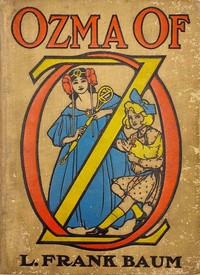
Baum's author's note directly addresses his young readers, crediting their letters with demanding "more about Dorothy" and prompting this sequel. The note reveals that children suggested plots and asked specific questions about characters' fates, making the book's genesis unusually transparent. The catalog subjects list twenty-one distinct topics, from "Hens -- Juvenile fiction" to "Steamboats -- Juvenile fiction," but the excerpts show that the actual narrative quickly moves beyond simple enumeration: the opening chapter's storm sequence builds waves into billows "higher even than the tops of houses" through incremental repetition, a stylistic choice that emphasizes process over static description.
Mechanical Men and Talking Hens
The catalog includes "Magic -- Juvenile fiction" and "Physicians -- Juvenile fiction," but the excerpts introduce two characters that defy easy categorization. Tiktok is described as a "machine man" who "can-not think" and must be wound up to speak, move, and think separately—a literal embodiment of clockwork logic. Billina the yellow hen, by contrast, is a barnyard animal who gains speech and personality without explanation. The text treats both as matter-of-fact presences: Dorothy converses with the hen as naturally as she does with the Scarecrow. This pairing of the mechanical and the organic suggests that Baum's Oz operates on a principle of inclusion rather than consistency, where a wind-up copper man and a talking chicken coexist without narrative friction.
The Hammer Gauntlet and Group Dynamics
The extended scene under the giant's hammer reveals how Baum distributes agency among his large cast. The Cowardly Lion, despite trembling "like a leaf in the wind," volunteers to go first, and the Hungry Tiger follows. The Scarecrow devises the plan after "thinking it over" in private. Tiktok and the Tin Woodman cross with calm precision. But the twenty-six officers and the private cannot move—their "knees shake so that we cannot run." The Lion and Tiger must rescue them two at a time. This division of labor is not random: each character's method of crossing matches their established traits. The scene functions as a compressed demonstration of the group's internal hierarchy, where courage, intellect, and physical design each have distinct roles.
The Catalog's Limits as a Plot Map
The catalog subjects list "Vacations -- Juvenile fiction" and "Uncles -- Juvenile fiction," yet the excerpts contain no vacation scenes or uncle characters. Dorothy's uncle Henry is mentioned in the title page's list of characters but does not appear in the provided text. Similarly, "Steamboats -- Juvenile fiction" appears in the catalog, but the opening chapter describes a storm at sea, not a steamboat journey. These discrepancies highlight how catalog metadata can suggest themes that the actual narrative handles differently or omits entirely. The excerpts show that Baum's story is less about domestic travel or family relationships than about assembling a diverse party to undertake a rescue mission in a foreign fairyland. Readers relying solely on the subject headings might expect a cozy vacation story; the text delivers a mechanical giant, a shape-shifting Nome King, and a princess in disguise.
Baum's note mentions that one child reader called Billina "REAL OZZY," a phrase that captures the book's tone: whimsical yet grounded in practical problem-solving. Readers will find that the narrative rewards attention to how each character's limitations—whether mechanical, emotional, or physical—become part of the group's collective resource. The excerpts offer a sample of Baum's method: introduce a fantastical obstacle, then resolve it through character-specific action rather than arbitrary magic.
I finished Ozma of Oz and it stayed with me—how the children’s letters shaped Baum’s story, making it feel almost tender, like a shared secret. That same gentleness lives in Our Davie Pepper — Background and Themes, where home and resilience feel quietly familiar. It wasn’t loud, just warm, the way some books hold your hand long after the last page. I thought of you when I closed it.