About 416 minutes
Our Davie Pepper — Background and Themes
Fantasy Juvenile Worlds
95,526 recorded words. 6 minutes difference from this book's estimate.
View Gutenberg source #71215
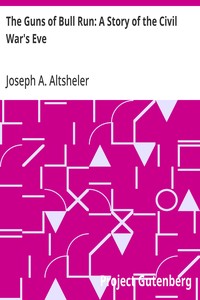
The catalog record for The Guns of Bull Run: A Story of the Civil War's Eve — Inside the Classic provides practical reading context through 94,094 words, 6 hr 50 min estimated reading time, and 9 detected text sections.
The text analysis averages about 15.8 words per sentence, while the detected sections provide another way to judge how the source is divided.
Project Gutenberg metadata also associates the work with “Bull Run, 1st Battle of, Va., 1861 -- Juvenile fiction,” connecting these edition facts with the source record’s subject description.
Explore this collection
These alternatives are selected using recorded categories and estimated reading time.
About 416 minutes
Fantasy Juvenile Worlds
95,526 recorded words. 6 minutes difference from this book's estimate.
View Gutenberg source #71215About 376 minutes
Fantasy Juvenile Worlds
86,394 recorded words. 34 minutes difference from this book's estimate.
View Gutenberg source #75657About 361 minutes
Fantasy Juvenile Worlds
82,906 recorded words. 49 minutes difference from this book's estimate.
View Gutenberg source #72455Search stored excerpts and compare books → Choose by your preferences →
Choices use stored catalog measurements. Estimates vary with reading speed. A shared category is a catalog label, not a claim that two books have the same argument or literary quality.
Search reads excerpt text stored with this catalog and links to its associated Gutenberg record. The connection is stored in the site database; this tool does not recheck that every excerpt is word-for-word identical to that external record. Excerpt search does not cover every chapter and does not verify historical publication dates.
Catalog snapshot checked: 2026-09-25. Coverage: 97 public books, 97 available source excerpts.
Read the complete public-domain text at its original source.
Read on Project GutenbergThe novel opens with Harry Kenton, a young Kentuckian, navigating the tense political landscape of Frankfort as the state debates secession. Altsheler quickly establishes a pattern of contrasts: the loyalties of mountaineers are split between Union and Confederacy, embodied by the helpful Samuel Jarvis and the hostile Bill Skelly. Harry’s near-drowning and rescue by Jarvis, who treats his bruises with Indian oil, sets up a recurring motif of unexpected aid from rough-hewn characters. The narrative voice is direct, favoring action over introspection, and the dialogue carries regional flavor—Jarvis’s dialect (“don’t furgit”) marks him as a distinct type.
Altsheler draws a sharp line between two mountaineer archetypes. Samuel Jarvis, the singing raftsman, is pragmatic and neutral: “don’t make me take any part in it” regarding secession. His nephew Ike is a “lunkhead,” but both are honest traders. In contrast, Bill Skelly is a guerrilla who attacks Harry’s home and later tries to drown him. Colonel Kenton explicitly frames this as a moral geography: “There are bad mountaineers and good mountaineers.” The novel uses these figures to dramatize the fractured loyalties of Kentucky, a border state where neighbor turns against neighbor. The oil from “Aunt Suse,” a centenarian prophetess, adds a folkloric layer, suggesting that ancient remedies and wisdom persist amid modern conflict.
The relationship between Harry and his father, Colonel George Kenton, is built on restrained affection and strategic calculation. When Harry reports his attack, Colonel Kenton listens “intently and rarely interrupting,” then calmly concludes that Harry must leave Frankfort for his safety. He has already planned Harry’s next step: a letter from Colonel Leonidas Talbot offers a staff position in Richmond. Harry’s eagerness (“I could go in an hour”) contrasts with his father’s measured tone. The colonel smiles “out of the corner of his eyes,” a small gesture that conveys pride without sentimentality. Altsheler uses this dynamic to show how the war accelerates young men’s ambitions while forcing older men to make hard decisions.
Frankfort is depicted as a small town with “few lights,” where the Capitol’s lit windows signal the nocturnal work of politicians. Harry observes “men still at work, striving to draw a state into the arms of the North or the South.” The physical journey—from the river to the hotel—mirrors the political drift. The Kentucky River itself becomes a site of violence (the drowning attempt) and rescue (the raft). Altsheler’s descriptions are functional: the “dusk,” the “flame of lamps,” the “lawn” where Harry pauses to breathe. These details ground the political drama in a tangible, almost claustrophobic setting. The novel’s geography is never neutral; every location carries the weight of allegiance.
Readers should attend to how Altsheler balances historical exposition with personal stakes. The novel’s title promises battle, but the early chapters focus on the moral and physical journey toward it. Harry’s movements—from Pendleton to Frankfort to Richmond—trace the Confederacy’s own consolidation. The mountaineers, the father-son exchanges, and the river all serve as microcosms of a nation dividing. The text rewards attention to dialect, gesture, and the precise weight of a character’s silence.
I found myself thinking of Harry Kenton’s restless wander through Kentucky, that odd mix of belonging and not-yet-belonging, when I recalled John Tincroft’s quieter path toward the same kind of settling. Both men seem to carry their homes with them, uneasy until the ground finally gives way. It’s a strange, familiar ache. John Tincroft, bachelor and benedict — Text and Context felt like an echo of that same tension, softened by age.
Your answers remain private and are stored only in this browser.