About 219 minutes
Another year with Denise and Ned Toodles — Themes and Context
Wandering Heroes Classic Adventures
50,305 recorded words. 4 minutes difference from this book's estimate.
View Gutenberg source #76807
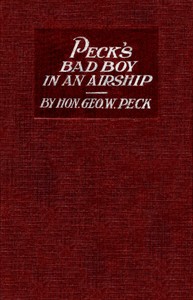
The source record for Peck's Bad Boy in an airship — Story, Setting & Ideas measures this digital text at 51,212 words, 3 hr 43 min estimated reading time, and 26 detected text sections.
The text analysis averages about 44.0 words per sentence, while the detected sections provide another way to judge how the source is divided.
Project Gutenberg metadata also associates the work with “Orphans -- Juvenile fiction,” connecting these edition facts with the source record’s subject description.
Explore this collection
These alternatives are selected using recorded categories and estimated reading time.
About 219 minutes
Wandering Heroes Classic Adventures
50,305 recorded words. 4 minutes difference from this book's estimate.
View Gutenberg source #76807About 217 minutes
Wandering Heroes Classic Adventures
49,818 recorded words. 6 minutes difference from this book's estimate.
View Gutenberg source #75952About 241 minutes
Wandering Heroes Classic Adventures
55,334 recorded words. 18 minutes difference from this book's estimate.
View Gutenberg source #69609Search stored excerpts and compare books → Choose by your preferences →
Choices use stored catalog measurements. Estimates vary with reading speed. A shared category is a catalog label, not a claim that two books have the same argument or literary quality.
Search reads excerpt text stored with this catalog and links to its associated Gutenberg record. The connection is stored in the site database; this tool does not recheck that every excerpt is word-for-word identical to that external record. Excerpt search does not cover every chapter and does not verify historical publication dates.
Catalog snapshot checked: 2026-09-25. Coverage: 97 public books, 97 available source excerpts.
Read the complete public-domain text at its original source.
Read on Project GutenbergThe narrative voice in Peck's Bad Boy in an Airship is the boy himself, speaking in a colloquial, irreverent tone that consistently undercuts his father's authority. From the opening chapters, the boy describes his Pa as a man who “began to shuck himself” after a boast, and later notes that “Pa is so scared he stays in his tent most of the time and shivers.” This first-person perspective shapes the entire adventure, filtering events through a child's skeptical and mischievous lens.
Despite the catalog listing “Airships” as a subject, the excerpts focus far more on the boy's relationship with his father and their encounters with wild animals in South Africa than on the airship itself. The airship appears primarily as a prop for travel and comic situations, such as when the boy notes that filling the gas bag will likely scare away all the native laborers.
The boy's narration is the engine of the book's humor. He reports his father's boasts with deadpan accuracy, then immediately reveals the reality. When Pa claims he will “make any animal that crosses my path think he has run into a live wire,” the boy comments, “Well, I hope Pa will not be a coward.” This pattern recurs throughout the excerpts: Pa talks big, the boy observes his fear, and the comedy arises from the gap between word and deed.
The boy also uses exaggerated comparisons to heighten the effect. He describes rubbing Pa down “as if he was a race horse,” and notes that Pa's heart “comes up in his mouth, and chokes him.” These details are specific to the text and show a consistent authorial strategy: the boy's voice is not merely childish but deliberately crafted to expose adult pretension.
The South African sections dominate the excerpts, with vivid descriptions of the landscape and its inhabitants. The boy notes that “you can have any kind of climate you are looking for, from the Alaska kind to the tropical kind, the same day,” and attributes the animals' aggression to this variability. His observations about the native people are laced with period stereotypes: he describes them as wearing “a doily, made of bark or grass” and having skin “thick and warty like a rhinoceros.”
A recurring comic thread involves a native chief with sixty wives, who have “their caps set for Pa.” The boy worries that if the chief dies, Pa will be selected as husband, and he imagines having to be “a stepson to all those sixty senegambians.” This plotline, while reflecting the era's racial attitudes, provides a specific source of tension and humor that is unique to this book.
Despite the title and catalog subjects, the airship itself receives surprisingly little attention in the excerpts. The boy and his Pa acquire it in Germany, but the narrative quickly moves to South Africa, where the airship is described as a “gas bag” that will “flop around.” The boy's interest is not in the technology but in its potential for chaos: scaring natives, hunting animals, and embarrassing his father.
The catalog lists “Airships” as a primary subject, but the excerpts suggest the airship functions more as a plot device than a focus of genuine exploration. The government assignment to investigate airships for the Navy is mentioned in the table of contents, but the actual text dwells on the boy's antics and Pa's discomfort. Readers expecting detailed aeronautical descriptions will find instead a comedy of manners set in exotic locales.
Readers approaching this book should expect a first-person comic adventure driven by the boy's irreverent voice and his father's comic cowardice, rather than a technical or plot-heavy narrative. The South African episodes, with their period-typical cultural commentary and animal encounters, form the core of the excerpts. The airship, despite its prominence in the title, serves primarily as a means to get the characters into humorous situations. The book rewards those who enjoy early 20th-century American humor and the dynamics of a mischievous child narrator.
There’s something about Peck’s Boy—his stubborn, sideways view of the world—that made me think of another old story, one where a young master learns that grand houses hold quieter rebellions. Both boys seem to resist the roles adults hand them. I found myself lingering on that shared stubbornness. The young master of Hyson Hall — Themes and Context came to mind, a gentler echo of the same feeling.
Your answers remain private and are stored only in this browser.