About 243 minutes
Gay's year on Sunset Island — Reading Notes
Wandering Heroes Classic Adventures
55,852 recorded words. 8 minutes difference from this book's estimate.
View Gutenberg source #76532
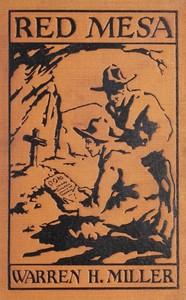
Before opening Red Mesa — Text and Context, the edition data offers a quick orientation: 57,642 words, 4 hr 11 min estimated reading time, and 18 detected text sections.
The text analysis averages about 15.6 words per sentence, while the detected sections provide another way to judge how the source is divided.
Project Gutenberg metadata also associates the work with “Western stories,” connecting these edition facts with the source record’s subject description.
Explore this collection
These alternatives are selected using recorded categories and estimated reading time.
About 243 minutes
Wandering Heroes Classic Adventures
55,852 recorded words. 8 minutes difference from this book's estimate.
View Gutenberg source #76532About 241 minutes
Wandering Heroes Classic Adventures
55,334 recorded words. 10 minutes difference from this book's estimate.
View Gutenberg source #69609About 279 minutes
Wandering Heroes Classic Adventures
63,953 recorded words. 28 minutes difference from this book's estimate.
View Gutenberg source #71952Search stored excerpts and compare books → Choose by your preferences →
Choices use stored catalog measurements. Estimates vary with reading speed. A shared category is a catalog label, not a claim that two books have the same argument or literary quality.
Search reads excerpt text stored with this catalog and links to its associated Gutenberg record. The connection is stored in the site database; this tool does not recheck that every excerpt is word-for-word identical to that external record. Excerpt search does not cover every chapter and does not verify historical publication dates.
Catalog snapshot checked: 2026-09-25. Coverage: 97 public books, 97 available source excerpts.
Read the complete public-domain text at its original source.
Read on Project GutenbergThe opening chapter of Red Mesa immediately establishes a partnership between two distinct characters: the rangy, determined youth Sid and the leathery cowman Big John, whose folksy reluctance to climb cliffs is presented as "mere camouflage." Their search for Honanki Ruins, guided by a map from archaeologist Fewkes, is framed as a quest for inaccessible places. The prose pays close attention to the Arizona landscape—cliffs banded "like layer cake" in red, ochre, blue, green, and white—and to the Airedale dog Ruler, who prowls with "snuffing nose." This trio of human, animal, and setting forms the core of the narrative's early action.
The excerpts reveal that Miller relies heavily on colloquial dialogue to define his characters. Big John's speech is peppered with western vernacular: "It'd take a horned toad with suckers on his feet to bust her, Siddy son." Sid, in contrast, uses a more formal but still youthful idiom, punctuated with exclamations like "by jerry." Their banter—"You mosey up—an' I'll hold yore hoss!"—serves both to advance the plot and to establish a dynamic of feigned reluctance versus genuine eagerness. This verbal interplay is the primary vehicle for characterization, rather than interior monologue or authorial description.
The Arizona setting is not merely backdrop but an active element in the story. Cliffs are described as "chimneys" requiring "seven hundred feet of sheer ascent," and the mesa itself is a fortress. When Sid is held in the Apache village, the environment is detailed with precision: patches of maize planted "as the Hopi plant them," squash vines growing from crevices, and a deep gorge containing a vein of copper and silver ore. The landscape offers both danger (the inaccessible ruins) and opportunity (the mine), and the characters' relationship to it is practical rather than romantic.
The catalog subject "Indians of North America -- Juvenile fiction" is borne out by the excerpts, but the portrayal is filtered through Sid's perspective. The Apache chief Honanta speaks in a formal, almost ceremonial register: "Go, my young brother! You are free of our village." The narrative notes that the villagers are "sunburned black as negroes," a description that reflects early twentieth-century racial assumptions. Sid's primary concern is escape and rescue via his dog Ruler, and he worries that Scotty's "mineralogical knowledge" will lead to the end of the Yellow Bear clan's peaceful days. The excerpts do not develop the Apache characters beyond their functional roles in the plot.
Readers approaching Red Mesa should attend to how the catalog subjects—Western, adventure, Indian lore—are filtered through a juvenile adventure lens. The excerpts show a story driven by dialogue and physical action, with the landscape as a constant presence. The incomplete text leaves questions about the resolution of the mine plot and the fate of the Apache village, but the surviving chapters offer a clear sense of Miller's style: brisk, colloquial, and attentive to the practical details of survival in the Southwest.
Reading Red Mesa made me recall the long afternoons I spent as a child, imagining my own hidden canyon behind the sofa, with only a patient dog for company. That same hush of discovery, that sense of a world just out of sight, came back to me years later with The Bunnikins-Bunnies and the Moon King — Context and Discussion, where the quiet wonder felt just as familiar.
Your answers remain private and are stored only in this browser.