About 63 minutes
Friend and foe — Text and Context
Fantasy Juvenile Worlds
14,398 recorded words. 3 minutes difference from this book's estimate.
View Gutenberg source #72968
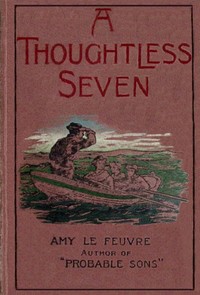
A thoughtless seven — Key Ideas to Explore can be approached with a clearer sense of reading commitment from its source measurements: 13,740 words, 1 hr estimated reading time, and 2 detected text sections.
The text analysis averages about 16.0 words per sentence, while the detected sections provide another way to judge how the source is divided.
Project Gutenberg metadata also associates the work with “Christian life -- Juvenile fiction,” connecting these edition facts with the source record’s subject description.
Explore this collection
These alternatives are selected using recorded categories and estimated reading time.
About 63 minutes
Fantasy Juvenile Worlds
14,398 recorded words. 3 minutes difference from this book's estimate.
View Gutenberg source #72968About 64 minutes
Fantasy Juvenile Worlds
14,559 recorded words. 4 minutes difference from this book's estimate.
View Gutenberg source #71949About 72 minutes
Fantasy Juvenile Worlds
16,459 recorded words. 12 minutes difference from this book's estimate.
View Gutenberg source #76977Search stored excerpts and compare books → Choose by your preferences →
Choices use stored catalog measurements. Estimates vary with reading speed. A shared category is a catalog label, not a claim that two books have the same argument or literary quality.
Search reads excerpt text stored with this catalog and links to its associated Gutenberg record. The connection is stored in the site database; this tool does not recheck that every excerpt is word-for-word identical to that external record. Excerpt search does not cover every chapter and does not verify historical publication dates.
Catalog snapshot checked: 2026-09-25. Coverage: 97 public books, 97 available source excerpts.
Read the complete public-domain text at its original source.
Read on Project GutenbergThe narrator, who goes by the nickname Li (short for Lightning), opens with a Sunday afternoon scene of deliberate disorder: siblings sprawled on a couch, coal-scuttle, and hearthrug, roasting chestnuts and defying their absent governess. The seven children have just recovered from scarlet fever, and their parents are abroad. Li’s voice is brisk, colloquial, and self-aware—she explains that their baptismal names were ‘too respectable’ and that she and her brother Thunder ‘invariably did things together.’ The catalog subjects list Christian life, conduct, and nannies, but the excerpts foreground the children’s invented nicknames, their gleeful rule-breaking, and the physical comedy of a thrown nut that hits a brother’s nose.
The seven siblings—Pat, Taters, Honey, Thunder, Li, Doodle-doo, and Pixie—use only self-coined names, a detail that signals their collective identity against adult authority. Li reports that the eldest, Pat, is ‘in his eighteenth year,’ and that the youngest, Pixie, is ‘a delicate little fellow of six’ who fared worst in the fever. The opening chapter shows them relishing their freedom: they plan to ‘have a good fling’ while the governess is away, and Li throws a chestnut at Pat’s nose ‘with such exact precision’ that he chases her. The catalog subject ‘Amusements’ is borne out by the chestnut roasting and later sand-castle building, but the excerpts emphasize that these amusements are framed as defiance, not innocent play.
Li’s religious conversion occurs between chapters, and the excerpts show her brothers’ skeptical reaction. Pat mocks her with a caricature: ‘a kind of what-a-good-girl-am-I smirk’ and ‘a oh-how-frivolous-is-earth roll in the whites of her eyes.’ Li inspects her own face in a mirror, wishing she could see a change. The catalog subject ‘Christian converts’ is thus depicted not as a solemn event but as a source of family tension. Li’s sister Honey later says, ‘You’re an awfully queer Christian,’ and Li admits she cannot be perfect all at once, quoting a letter from Miss Moffat: ‘Don’t think you won’t tumble, my dear; young feet are very uncertain.’ The excerpts do not reveal how the conversion began or whether it lasts.
In Chapter VI, Li describes a day of losing her temper, being rude, and smashing a lamp, then tells Honey that ‘fresh days keep coming’ and offer a fresh start. Honey responds that Li is ‘not a proper’ Christian, but also reports that the boys admire her ‘pluck and perseverance.’ Li invites Honey to ‘come and see’ the Christian life, echoing the biblical phrase. The catalog subject ‘Conduct of life’ is here treated as a practical, daily struggle rather than a set of rules. Li’s language is concrete—‘I lost my temper with Taters, was rude to Fräulein’—and her hope rests on the idea that each day resets the effort. The excerpts do not show whether Honey accepts the invitation.
The excerpts offer a first-person narrative that is both candid about misbehavior and earnest about religious change, but they leave key questions open: how Li’s conversion came about, whether the siblings’ mockery persists, and what role the governess or nurse plays. Readers should attend to the tension between Li’s self-deprecating humor and her stated desire to be good, and to the way the story uses nicknames and physical comedy to offset its moral themes. The catalog subject ‘Scarlatina’ appears only as a past illness, not as a plot driver.
There’s something achingly familiar in Li’s seven siblings—that unruly, fever-shadowed house where nicknames are armor and faith arrives as a quiet, lonely ache. Reading her conversion, I kept thinking how childhood belief rarely stays tidy. It made me revisit Little Metacomet — A Closer Reading, which tracks that same flickering inner weather, but with softer light. Just a small, wistful echo between the two.
Use these questions to collect your thoughts before moving on.