About 122 minutes
The defender — Context and Discussion
Fantasy Juvenile Worlds
27,933 recorded words. 0 minutes difference from this book's estimate.
View Gutenberg source #77051
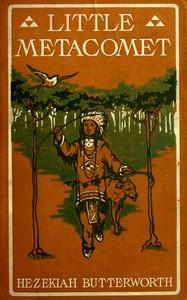
The source record for Little Metacomet — A Closer Reading measures this digital text at 27,899 words, 2 hr 2 min estimated reading time, and 26 detected text sections.
The text analysis averages about 14.0 words per sentence, while the detected sections provide another way to judge how the source is divided.
Project Gutenberg metadata also associates the work with “Animals -- Juvenile fiction,” connecting these edition facts with the source record’s subject description.
Explore this collection
These alternatives are selected using recorded categories and estimated reading time.
About 122 minutes
Fantasy Juvenile Worlds
27,933 recorded words. 0 minutes difference from this book's estimate.
View Gutenberg source #77051About 124 minutes
Fantasy Juvenile Worlds
28,340 recorded words. 2 minutes difference from this book's estimate.
View Gutenberg source #75785About 117 minutes
Fantasy Juvenile Worlds
26,847 recorded words. 5 minutes difference from this book's estimate.
View Gutenberg source #77024Search stored excerpts and compare books → Choose by your preferences →
Choices use stored catalog measurements. Estimates vary with reading speed. A shared category is a catalog label, not a claim that two books have the same argument or literary quality.
Search reads excerpt text stored with this catalog and links to its associated Gutenberg record. The connection is stored in the site database; this tool does not recheck that every excerpt is word-for-word identical to that external record. Excerpt search does not cover every chapter and does not verify historical publication dates.
Catalog snapshot checked: 2026-09-25. Coverage: 97 public books, 97 available source excerpts.
Read the complete public-domain text at its original source.
Read on Project GutenbergThe first chapter introduces Susan Barley, a woman who “was much afraid lest she should ‘see something.’” This phrasing immediately establishes a tone of gentle humor and domestic anxiety, set against the “green groves of Swansea” bordering Mt. Hope lands. The preface frames the book as a “little nature book” blending “much fact and a slight framework of fiction,” aiming to portray an Indian boy’s life before King Philip’s War. Readers should note how the opening uses Susan’s fear as a foil for the curiosity that will draw her son Roger into the woods.
The opening chapter dwells on Susan’s persistent worry about “seeing something,” a phrase repeated to underscore her timidity. This is not a generic character trait but a specific response to her environment: she lives in Swansea, a borderland between English settlements and Wampanoag territory. The text does not yet reveal what she fears—whether wild animals, Indians, or supernatural beings—but the vagueness creates suspense. The author uses her anxiety to justify why her son Roger might seek adventure elsewhere. Readers should observe how Susan’s fear contrasts with the later scenes of open curiosity and friendship between Roger and Little Metacomet. The narrative does not mock her; instead, it treats her caution as a natural response to uncertain times.
In the middle excerpts, Roger’s bond with Little Metacomet develops through shared activities like the frog race and the gift of pancakes. The Indian boy’s speech is rendered in a stylized dialect: “You good to me—you give me pancakes.” This choice reflects the era’s literary conventions but also signals a reciprocal relationship—Roger’s kindness is rewarded with access to Wampanoag life. The friendship is not sentimentalized; it is built on concrete exchanges. When Roger asks about the races, Little Metacomet explains that winners receive moccasins and become runners who “carry words from one part of the country to another.” This detail grounds the friendship in practical, cultural knowledge rather than abstract goodwill.
The later excerpts shift to a panoramic description of Mt. Hope, Philip’s “throne cliff” overlooking the bay. The prose becomes lush and specific: “the shores were shaded by great oaks, and the rocks were green with savins.” The narrative catalogs plants—arbutus, laurel, sumac, wild aster—and situates the setting within a longer history, referencing Verrazzano and the Northmen. This is not mere decoration; it establishes Mt. Hope as a place of layered significance, both natural and historical. The description of the race includes sensory details: the queen’s “red robes and glittering pearl shells,” the drums, the semicircle of warriors. Readers should note how the landscape is tied to action—the race course runs from the hilltop to a rock and into the tide.
The climax of the provided excerpts is the footrace and swimming contest. Twelve youths start from the hill, “seemed to fly,” then leap a rock and swim. The winner is a shorter, nimbler boy, but the focus shifts to Roger when the princess approaches him. She lays a hand on his shoulder and says, “These are for you. You have a good mother.” The moccasins are “decorated with pearl,” a mark of honor. This moment is pivotal: Roger is publicly recognized by the Wampanoag queen, linking his family’s reputation (the “good woman of the haystack”) to his own acceptance. The scene suggests that the friendship has broader implications, though the excerpts do not reveal how this honor affects the plot.
Readers approaching Little Metacomet for the first time should pay attention to how Butterworth balances fiction with ethnographic detail. The excerpts show a pattern: domestic scenes (Susan’s fear, pancake-making) give way to outdoor adventures (races, bird-taming), which then open into historical panorama. The author’s preface warns that the book uses a “slight framework of fiction” around factual material; the early chapters establish that framework, while the later ones deliver the promised nature study. The friendship between Roger and Little Metacomet is the thread that connects these modes.
Reading about Susan Barley’s quiet dread on that hill, I remembered sitting on my grandmother’s porch with a dog-eared copy of Little Metacomet, feeling the same hush—how friendship softens fear without erasing it. That tender ache returned while revisiting The Donovan chance — Key Ideas to Explore, where a boy’s loneliness slowly warms into something shared, like morning light on water. Both left me holding my breath, then letting it go.
Create a short personal record of your experience with this book.