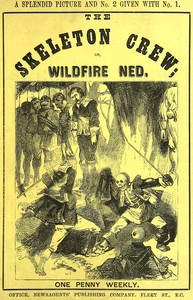
The opening chapter of The Skeleton Crew; or, Wildfire Ned establishes a wintry setting with deliberate contrasts: the cheerful warmth of the “Black Bull” inn, where fiddles and laughter accompany a Christmas dance, versus the “bitter, bitter cold” outside and the “melancholy flutterings” of leafless trees. The narrator’s eye moves from the moonlit landscape to the shadowy figure of a “powerful-looking youth” on a bench—a classic penny-dreadful tableau that signals impending disruption.
Throughout the excerpts, the author relies on stock epithets and hyperbolic gestures. Characters are introduced with tags like “demon-like sneer” or “grinned like a fiend,” and dialogue often serves to advance capture or revelation rather than psychological depth. The prose is brisk, favoring action over interiority, and the setting shifts rapidly from rural inn to subterranean cavern, each location sketched with a few vivid details—trickling water, whitish soil, baize coats and pistols—that evoke a world of physical danger and moral extremity.
Diction and the Rhetoric of Villainy
The author’s word choices consistently amplify menace and moral polarity. Villains are described with animalistic or supernatural comparisons: Captain Jack wears a “demon-like sneer,” Sir Andrew “grinned like a fiend,” and Phillip Redgill is “very old in crime.” Such phrasing leaves no ambiguity about character alignment. The narrator also employs intensifiers like “violent jerking,” “powerful men,” and “rough beard” to heighten physical threat. Even the landscape participates: trees “bowed and shook” with “melancholy flutterings” that mimic human distress. This diction creates a world where every element—weather, architecture, gesture—reinforces the struggle between innocence and corruption.
Dialogue as Plot Engine
Dialogue in the excerpts rarely reveals interiority; instead, it drives capture, betrayal, and exposition. Captain Jack’s line “I have fulfilled my part of the bargain, Colonel, about the thirteen gibbets” condenses backstory into a single threat. Tim’s protest “I ain’t made of cast-iron” contrasts with Ned’s stoic “do you hear me say anything?”—a quick exchange that establishes character through verbal mannerism. The author uses dialogue to deliver revelations (“Betrayed!”) and to mark shifts in power, as when Captain Jack addresses Colonel Blood “in a different tone.” These functional exchanges keep the narrative moving at the expense of naturalism, a hallmark of serialized adventure fiction.
Description of Setting and Physical Detail
The author sketches settings with economical, sensory details that serve the plot. The cavern in Chapter XL is evoked through “whitish colour, similar to that in a lead mine,” “water trickling down,” and “a stagnant pool”—details that suggest both realism and claustrophobia. The coiners’ attire is itemized: “coarse baize coats,” “leather breeches,” “large top boots,” and “double-barrelled pistols.” Such specificity grounds the fantastical in the material. Similarly, the opening scene’s “deep shadows of its old, overhanging thatch-covered eaves” creates a visual anchor for the hidden youth. These descriptions are functional, not decorative; they establish the physical stakes of each scene.
Structure and Serial Pacing
The excerpts reveal a narrative built for serial publication: each chapter ends with a hook or reversal. Chapter I closes with the mysterious horseman’s arrival; Chapter XL ends with Ned bound and led through a cavern. The author uses cliffhangers and rapid scene shifts—from tavern to prison to riding party—to sustain momentum. The prose is episodic, with characters appearing and disappearing as needed. The repeated use of “But to return to Ned” signals a narrative that juggles multiple threads. This structure prioritizes suspense over coherence, rewarding readers who follow week to week.
Readers approaching The Skeleton Crew should expect a fast-paced, morally unambiguous adventure where language and description serve the plot above all. The author’s choices in diction, dialogue, and setting are not subtle but effective: they create a world of clear heroes and villains, physical peril, and constant motion. Pay attention to how the narrator uses stock phrases and exaggerated gestures—these are the tools that made the penny dreadful a popular form, and they reward a reader attuned to the conventions of Victorian serial fiction.
There’s something about how The Skeleton Crew leaves you sitting with the cold of that snowbound village, even after the last betrayal fades. It reminded me, strangely, of the quieter warmth found in Ruth Fielding at Golden Pass — Reading Companion. Not the peril, but that lingering sense of people finding their way through the dark, together. I still think about that.