About 819 minutes
The skeleton crew — Context and Discussion
Technology Airships Imagined Futures
188,239 recorded words. 134 minutes difference from this book's estimate.
View Gutenberg source #70734
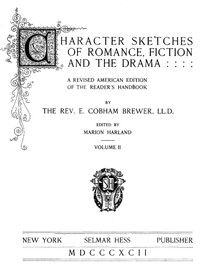
Before opening Character Sketches of Romance, Fiction, and the Drama, Vol. 2 A Revised American Edition of the Reader's Handbook — A Reader’s Guide, the edition data offers a quick orientation: 219,085 words, 15 hr 53 min estimated reading time, and 41 detected text sections.
The text analysis averages about 13.6 words per sentence, while the detected sections provide another way to judge how the source is divided.
Project Gutenberg metadata also associates the work with “Literature -- Dictionaries,” connecting these edition facts with the source record’s subject description.
Explore this collection
These alternatives are selected using recorded categories and estimated reading time.
About 819 minutes
Technology Airships Imagined Futures
188,239 recorded words. 134 minutes difference from this book's estimate.
View Gutenberg source #70734About 277 minutes
Technology Airships Imagined Futures
63,531 recorded words. 676 minutes difference from this book's estimate.
View Gutenberg source #76223About 255 minutes
Technology Airships Imagined Futures
58,636 recorded words. 698 minutes difference from this book's estimate.
View Gutenberg source #76955Search stored excerpts and compare books → Choose by your preferences →
Choices use stored catalog measurements. Estimates vary with reading speed. A shared category is a catalog label, not a claim that two books have the same argument or literary quality.
Search reads excerpt text stored with this catalog and links to its associated Gutenberg record. The connection is stored in the site database; this tool does not recheck that every excerpt is word-for-word identical to that external record. Excerpt search does not cover every chapter and does not verify historical publication dates.
Catalog snapshot checked: 2026-09-25. Coverage: 97 public books, 97 available source excerpts.
Read the complete public-domain text at its original source.
Read on Project GutenbergThis second volume of Character Sketches of Romance, Fiction, and the Drama covers entries from 'Falkland' to 'Mark,' offering concise definitions and literary origins for hundreds of names, phrases, and allusions. The excerpts show a work that is less a narrative guide than a densely cross-referenced dictionary, with entries ranging from a few lines to several paragraphs. Editor Marion Harland's role is noted on the title page, but the text itself bears the stamp of the original compiler, the Rev. E. Cobham Brewer, whose voice emerges in terse, factual summaries and occasional moral asides.
The volume's structure is built around alphabetical entries, but the excerpts reveal a web of cross-references that often point to other volumes in the set. For instance, the entry on 'Impostors (Literary)' lists nine figures—from Chatterton to Joseph Smith—without linking to their individual character entries, suggesting the reader must consult multiple places for a full picture. The transcriber's note warns that none of these references are hyperlinked in the digital edition, preserving the print-era expectation that a reader would physically flip pages. This design assumes a dedicated user, not a casual browser, and rewards systematic consultation.
Marion Harland's editorship is announced on the title page, but her interventions are invisible in the excerpts. The text retains Brewer's original voice: entries on 'Improvisators' list names like Bernardo Accolti and Teresa Bandettini with bare dates, while the 'Impostors' entry includes moralizing phrases such as 'barefaced forgeries.' The catalog subjects classify the work under 'Literature -- Dictionaries' and 'Allusions,' yet the excerpts show a preoccupation with verifying authenticity—a theme that aligns with Victorian anxieties about literary fraud. Harland's role may have been to Americanize spellings or add illustrations (listed but absent), but the core remains Brewer's handbook.
The longest excerpt, 'Impostors (Literary),' reads as a cautionary catalogue of forgers, from Psalmanazar's fake Japanese identity to the Book of Mormon's disputed origins. Each entry follows a pattern: name, claim, exposure. The entry on Lauder, who falsely accused Milton of plagiarism, notes that 'several lines had been foisted in to make the parallels,' a detail that reveals Brewer's interest in the mechanics of deception. These mini-essays do not merely define terms; they judge them, aligning the volume with a broader Victorian project of sorting genuine from spurious cultural artifacts.
Readers approaching this volume should treat it as a period reference tool rather than a modern encyclopedia. The entries assume familiarity with a wide range of Western literature and history, and the cross-references demand patience. For those interested in how Victorian scholars organized literary knowledge, the book offers a fascinating snapshot—one that prioritizes moral classification over narrative summary.
Flipping past Falstaff and Faust, I remembered hunting my grandfather’s shelves for names I didn’t know. This catalog felt like a map of other people’s inner lives—each entry a door left ajar. A bad penny — Story, Setting & Ideas gave me that same hush, that sense of a world quietly ticking beneath the page.
Your answers remain private and are stored only in this browser.