About 277 minutes
When Oriole traveled westward — A Reader’s Guide
Technology Airships Imagined Futures
63,531 recorded words. 22 minutes difference from this book's estimate.
View Gutenberg source #76223
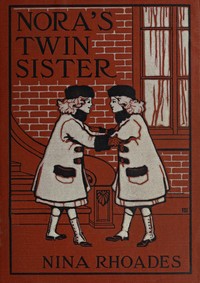
Nora's twin sister — Themes and Context can be approached with a clearer sense of reading commitment from its source measurements: 58,636 words, 4 hr 15 min estimated reading time, and 22 detected text sections.
The text analysis averages about 15.4 words per sentence, while the detected sections provide another way to judge how the source is divided.
Project Gutenberg metadata also associates the work with “Twins -- Juvenile fiction,” connecting these edition facts with the source record’s subject description.
Explore this collection
These alternatives are selected using recorded categories and estimated reading time.
About 277 minutes
Technology Airships Imagined Futures
63,531 recorded words. 22 minutes difference from this book's estimate.
View Gutenberg source #76223About 219 minutes
Technology Airships Imagined Futures
50,187 recorded words. 36 minutes difference from this book's estimate.
View Gutenberg source #76172About 206 minutes
Technology Airships Imagined Futures
47,272 recorded words. 49 minutes difference from this book's estimate.
View Gutenberg source #76493Search stored excerpts and compare books → Choose by your preferences →
Choices use stored catalog measurements. Estimates vary with reading speed. A shared category is a catalog label, not a claim that two books have the same argument or literary quality.
Search reads excerpt text stored with this catalog and links to its associated Gutenberg record. The connection is stored in the site database; this tool does not recheck that every excerpt is word-for-word identical to that external record. Excerpt search does not cover every chapter and does not verify historical publication dates.
Catalog snapshot checked: 2026-09-25. Coverage: 97 public books, 97 available source excerpts.
Read the complete public-domain text at its original source.
Read on Project GutenbergThe opening chapter of Nora's Twin Sister establishes a distinctive narrative voice through Nora's storytelling: she recounts a dream about a boy swallowing an orange-pit, delivered with dramatic pauses and direct speech. This oral quality contrasts sharply with the later, more restrained passages where Nora, impersonating her twin Kathleen, must suppress her natural talkativeness. The novel's language thus becomes a marker of identity, with Nora's bubbling speech set against Kathleen's measured instructions to 'not talk much.'
Rhoades builds tension through shifts in pace: the leisurely, domestic scene of Nora entertaining the Judsons gives way to the hurried, anxious rhythm of the Bermuda voyage, where every exchange carries the risk of exposure. The excerpts show a writer attentive to how dialogue and internal monologue can signal a character's comfort or constraint.
Nora's first lines in the novel are a lengthy, embedded tale about Tommy and the orange-pit, complete with repeated 'and' clauses and a moral punchline. This is not mere exposition; it establishes Nora as a performer of narrative, comfortable with elaboration and audience reaction. The passage uses a fairy-tale cadence—'he ran and ran till he came to the top of the kitchen stairs'—that Rhoades does not replicate for any other character. When Nora later impersonates Kathleen, she must abandon this voice, and the text becomes noticeably clipped: 'she merely answered questions, and made no voluntary remarks.' The contrast is sharp enough that a reader can track Nora's discomfort through the length and energy of her dialogue alone.
The Bermuda voyage section accelerates the narrative pace through short, tense exchanges and physical restlessness. Nora 'would have much preferred remaining where she was' but is pulled away by Sarah; Reggie's friendly chatter is cut off; the steamer's motion makes adults retreat to cabins. Rhoades uses the rocking ship as a physical analogue for Nora's precarious situation—every scene threatens to tip into exposure. The prose itself quickens: sentences become shorter ('Nora's face brightened. “Will you tell me some more of your adventures?” she asked, eagerly.'), and the paragraph breaks come more frequently. This is a marked shift from the unhurried, descriptive opening chapter, where Nora's story could unfold without interruption.
Kathleen, though largely absent from the excerpts, is defined by her absence of voice. Nora recalls Kathleen's 'instructions about not talking much,' and the narrative treats silence as a skill Nora must learn. When Nora does speak naturally, she is immediately suspected: Sarah's sharp 'You do, do you?' suggests that Nora's usual candor is out of place. Rhoades thus uses reported speech and internal monologue to build Kathleen as a foil—the twin who controls through quietness. The novel's language implies that identity is partly a matter of vocal habit, and that impersonation requires not just a change of clothes but a suppression of one's natural rhythm of speech.
Readers attentive to shifts in sentence length and dialogue density will find that Rhoades uses these technical choices to map Nora's emotional state. The novel rewards a slow reading that notices when a character's voice becomes stilted or expansive. Because the excerpts are incomplete, the full arc of Nora's linguistic adaptation—whether she ultimately reclaims her own voice—remains to be discovered in the later chapters.
Nora and Kathleen felt less like fiction and more like the two voices I keep in my own head—one rushing ahead, one holding back. Sometimes I wonder if I missed something the quieter one never said aloud. Old guides like Character Sketches of Romance, Fiction, and the Drama, Vol. 2 A Revised American Edition of the Reader's Handbook — A Reader’s Guide hold similar echoes, cataloguing lives we only glimpse once.
Create a short personal record of your experience with this book.